
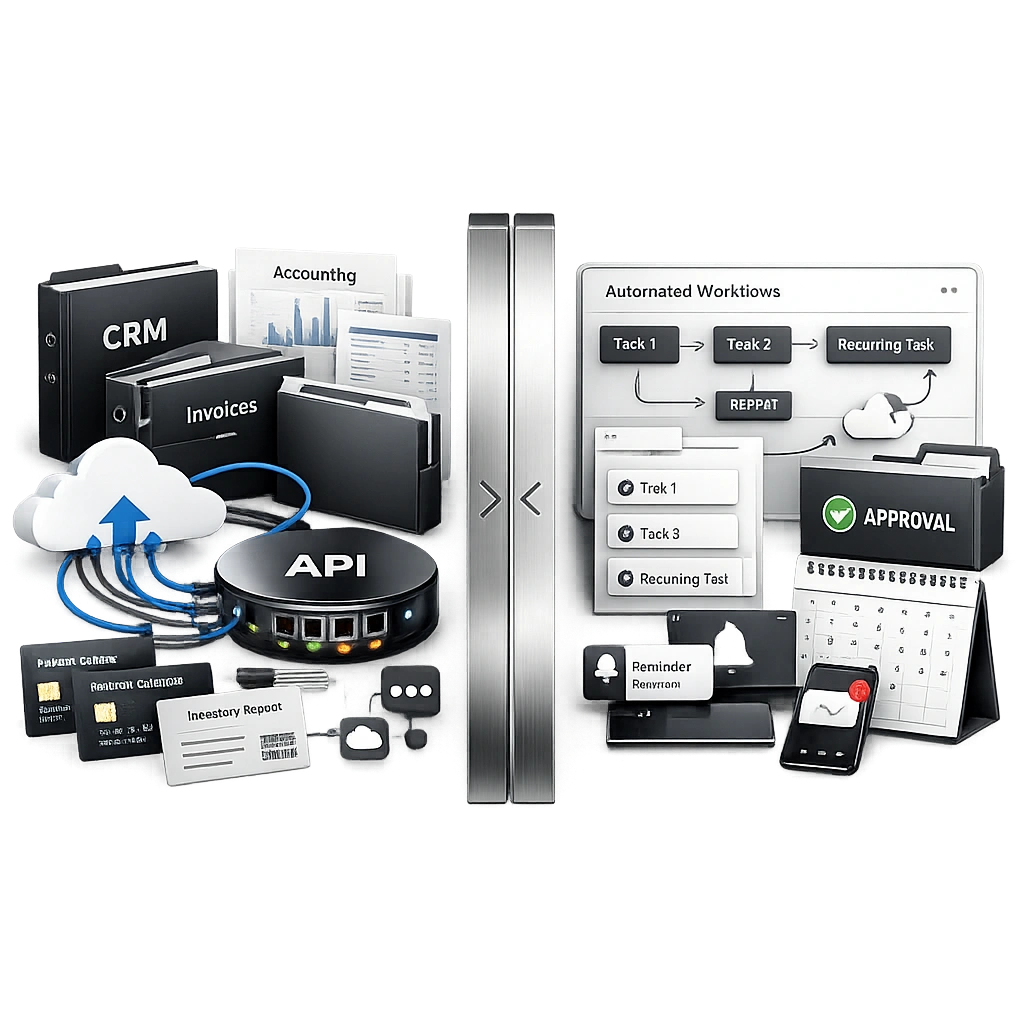
Workflow automation software development can help growing businesses avoid the hidden costs of disconnected systems. A growing business rarely chooses to build a messy technology stack. It happens gradually. Sales adopts a CRM, finance uses an accounting platform, customer support adds a ticketing tool and operations keeps several important spreadsheets alive because nothing else quite fits.
Each tool may work well on its own. The cost appears when people become the connection between them. Staff copy customer details, reconcile conflicting records, chase approvals and rebuild reports from several sources. The work looks small in isolation, so it often escapes serious attention. Across a week or a year, it becomes expensive.
These are some of the less obvious costs of disconnected systems and the signs that API integration services may be worth investigating.
Repeated data entry creates more than wasted time
Copying information from one system to another is slow, but the larger problem is inconsistency. A changed address may be updated in the CRM but not the billing platform. A cancelled order may remain active in a spreadsheet. A support agent may see an old customer status and give the wrong response.
Teams often add another checking step to reduce errors. That check becomes more manual work, and the process still depends on memory. Integration can allow approved data to move between systems automatically, with clear rules about which source is authoritative.
Reporting arrives after the decision was needed
When data sits in separate systems, useful reporting becomes a monthly construction project. Someone exports files, cleans column names, removes duplicates and tries to explain why totals do not match.
By the time the report is ready, the opportunity to act may have passed. A sales manager needs to know which leads are stalled now, not at the end of the month. Operations needs to see a backlog while it can still be managed.
Enterprise software development does not always mean replacing every platform. Sometimes a focused reporting layer and reliable integrations are enough to create a usable view.

Customers experience the gaps between departments
Internal systems may be invisible to customers, but broken handovers are not. A buyer repeats information already given online. A support team cannot see a recent order. Marketing continues sending introductory messages after a customer has purchased.
These moments make a business feel disorganised even when individual employees are trying hard. Connecting the systems around a customer journey can improve the experience without asking staff to remember another manual step.
Approvals become difficult to trace
Many organisations still manage approvals through email threads and chat messages. The request may begin in one system, the evidence lives in another and the final decision is recorded nowhere reliable.
Workflow automation can route a request to the correct person, collect the required information, send reminders and record the outcome. The benefit is not only speed. It creates an auditable process and makes bottlenecks visible.
Before automating, simplify the workflow. Automating a confusing process only makes confusion move faster.
Staff create unofficial workarounds
When systems do not support the real process, capable employees invent solutions. They build personal spreadsheets, save files locally or use an unsanctioned app to complete the task. These workarounds may keep the business moving, but they create security, continuity and compliance risks.
A departure or absence can expose how much operational knowledge was held by one person. Bespoke software development UK businesses commission is often most valuable when it turns an effective workaround into a controlled, shared process.
Simple changes become expensive
Disconnected processes are difficult to change because nobody can see every dependency. Updating a sales stage may affect a report, an email sequence, a spreadsheet and a finance task. Teams become cautious, and even small improvements take too long.
A well-designed integration strategy separates systems while allowing them to exchange the information they need. APIs act as defined routes for data and functions, which can make future changes easier to manage than a collection of one-off manual fixes.
How to decide what to fix first
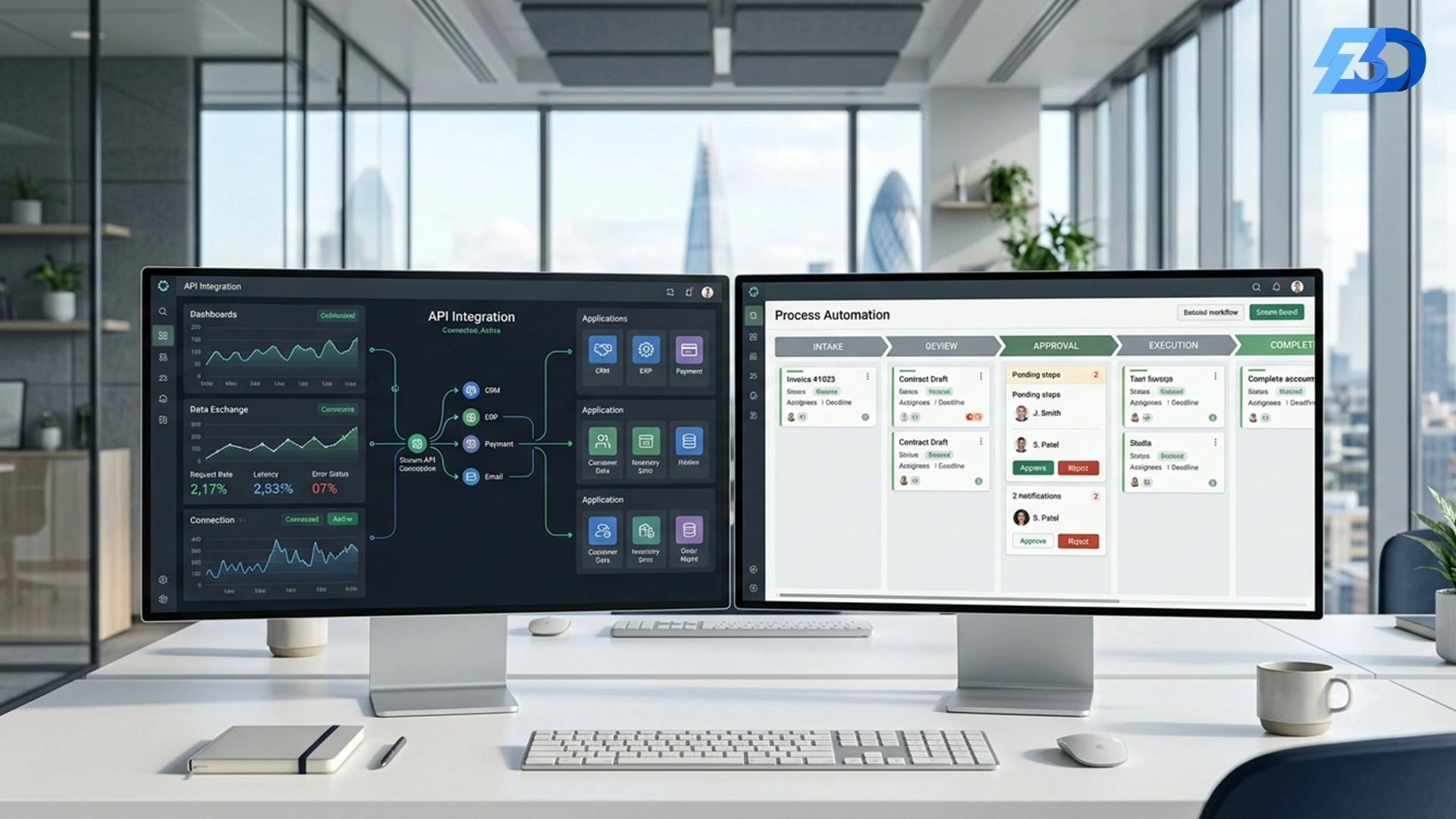
Do not begin by asking which automation platform to buy. Begin with the process. Choose one workflow that is frequent, frustrating and commercially meaningful. Map each step, system, person and decision. Record where information is retyped, delayed, checked or lost.
Businesses reviewing this area can also explore EMPWR3D’s guidance on API integration and workflow automation options.
Then decide whether the need is primarily integration, automation or a new application. Integration connects existing systems. Automation moves work through rules and triggers. A custom application may be appropriate when the process is central to the business and existing tools cannot support it cleanly.
A SaaS development agency UK businesses consult should be willing to recommend a small integration when a large platform is unnecessary.
Start with a controlled pilot
Choose a process with a clear owner and measurable outcome. Examples include creating an invoice when an order is approved, updating customer status across two platforms, routing website enquiries to the correct team or producing a daily operational dashboard.
Define what success means before building. It could be fewer manual steps, faster response, lower error rates or better visibility. Test exceptions as carefully as the normal route. Every real process has missing information, late approvals and unusual cases.
The purpose of integration and automation is not to remove people from every decision. It is to remove the repetitive movement of information so people can focus on judgement, service and improvement.
Final thought
Disconnected software rarely fails in one dramatic moment. It creates a steady tax on attention. Staff compensate, customers wait and managers make decisions with incomplete information.
The best first step is often modest: map one important workflow and remove one avoidable handover. That is how a business begins turning a collection of tools into a working system.
Frequently Asked Questions
1. What are disconnected business systems?
Yes. Disconnected systems are software platforms that do not share data effectively, causing duplicate work, errors and inefficient workflows.
2. Do disconnected business systems increase business costs?
Yes. They increase costs through manual data entry, reporting delays, errors, approval bottlenecks and wasted employee time.
3. Can API integration improve business efficiency?
Yes. API integration connects existing systems, automates data exchange and reduces repetitive manual tasks.
4. Should businesses use workflow automation software development?
Yes. It is useful for automating repetitive processes such as approvals, lead routing, invoicing and customer updates.
5. Is custom software development better than system integration?
No. Integration is often sufficient when existing systems can meet business needs; custom software is best when they cannot.